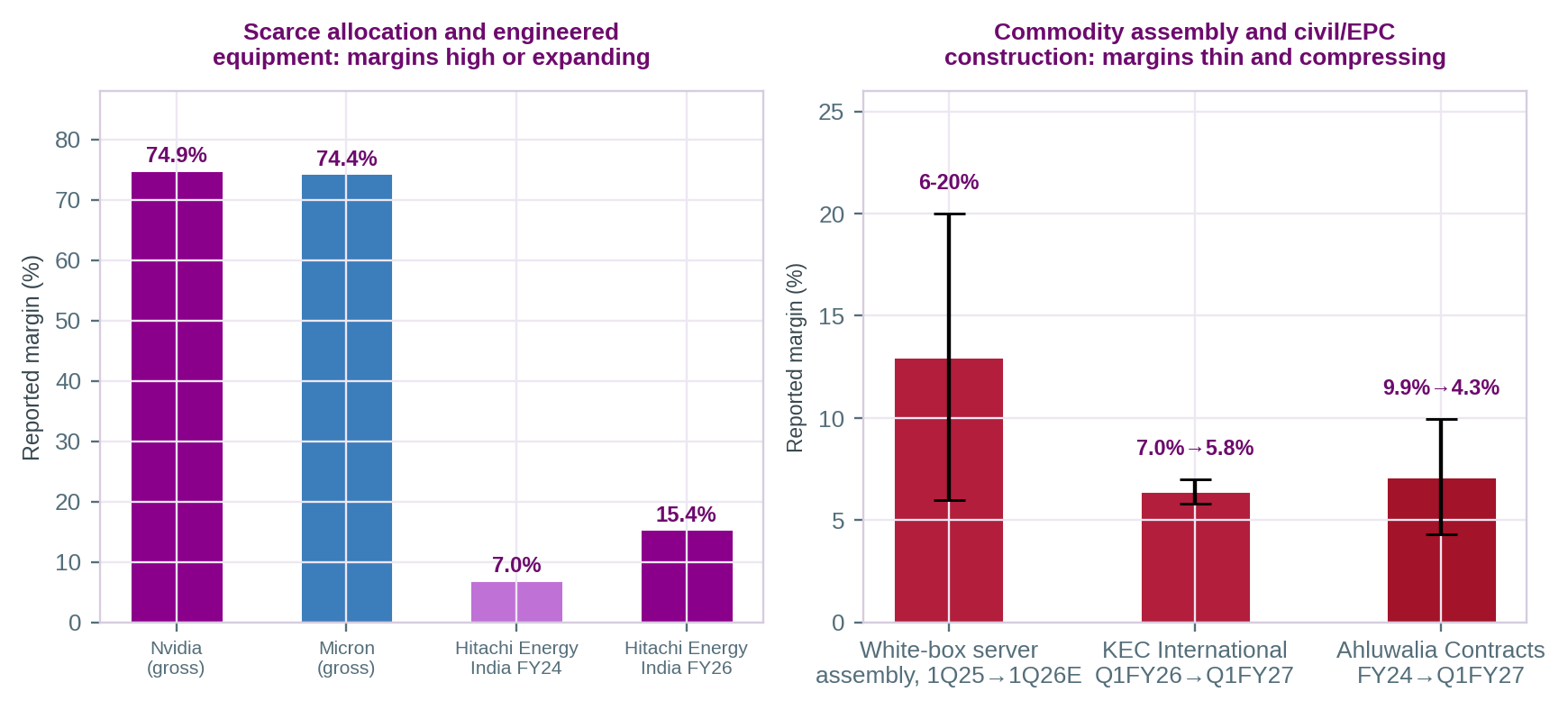
Three reasons the hard half does not scale the way the easy half does — and one honest structural difference between the two halves of this report's own stack, worth stating plainly.
A newly assembled server's success criterion is a burn-in test run today. A transformer's or cooling plant's success criterion is the absence of a failure that would only show up after months of sustained peak load. You cannot inspect your way to confidence at this layer, at either half of the stack; only running the system hard, for a long time, tells you whether the engineering was sound.
NVQual certification must be re-earned on almost every Nvidia architecture generation. A Tier III/IV facility's redundancy has to keep functioning correctly every time it is tested, for the facility's entire operating life, as equipment ages and is swapped without ever dropping below rated redundancy. Neither side of this stack lets a builder coast on a qualification earned once.
This is the one place the two halves of this stack genuinely diverge, and it matters enough to state explicitly rather than paper over for the sake of a tidy unified narrative. On the compute side, a single company — Nvidia — sets the qualification bar and effectively rations chip allocation; it is reported to be actively narrowing, not widening, the field of manufacturing partners it certifies. On the physical side, no single company or institution plays that role: scarcity there is a genuinely diffuse, global capital-equipment manufacturing-capacity constraint, layered on top of a fragmented set of domestic approvers (state electricity boards, the Central Electricity Authority, state-level industrial policy) with no single body granting or denying access. A concentrated gatekeeper can move fast in either direction — one Nvidia policy change reprices an entire industry overnight. A diffuse constraint moves slowly in both directions: it is harder to break into, but also harder for any single relationship or partnership to unlock. Read every power-equipment company's order-book growth in §9 against this distinction — it is genuinely a different, slower-moving kind of scarcity than the compute layer's, not a weaker version of the same thing.