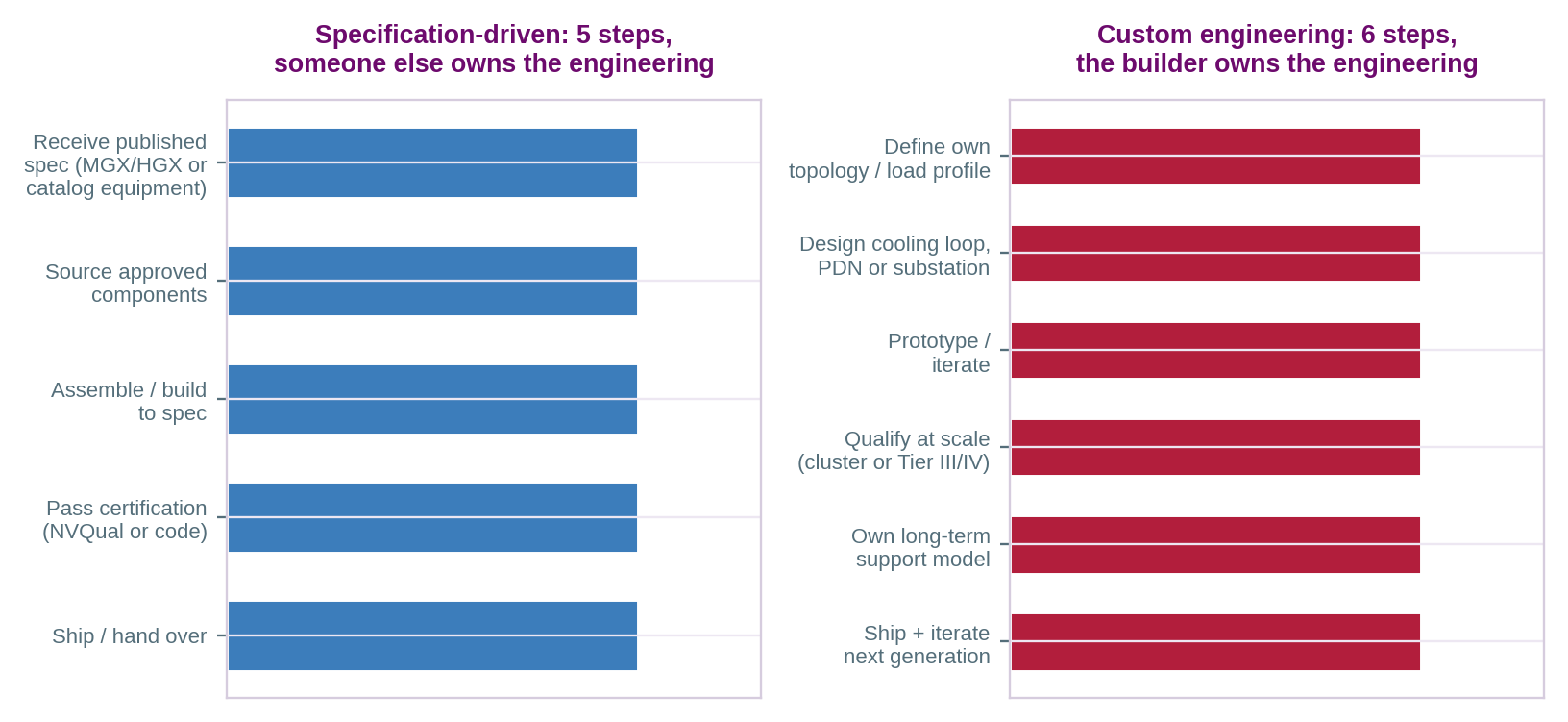
Why does a conventional operator get any work at this stack's hard layers at all? Because in a specification-driven build, someone else has already done the hard engineering. Nvidia has picked the chassis geometry and carries the qualification cost through NVQual; a catalog transformer or a generic building code has already been engineered by a standards body or a manufacturer, long before a specific project buys it. The "free input" here is someone else's systems-engineering, handed over as a specification — which is exactly why a commodity-grade operation still finds real work at every layer of this stack: someone else solved the hard half of this specific problem, and is renting out the easy half.
The alternative — custom engineering — inverts this at every layer. A hyperscaler designing its own rack from scratch; a power-equipment company engineering a purpose-built GIS substation around one specific campus's exact load and redundancy profile — both own the resulting intellectual property and capture whatever performance edge it delivers over an off-the-shelf build. Reading across this report's thirty-five companies in §9, the evidence on how many have genuinely walked through this door is mixed and worth taking layer by layer, not assumed uniformly optimistic or pessimistic: essentially none of the India-listed compute-stack universe has moved fully to custom engineering, while at least a handful of the physical-layer power-equipment names (Voltamp's order mix, ABB India's and Hitachi Energy's own management commentary on hyperscaler-specific engineering) show real, if partial, movement in that direction.
When a company report later in this document describes a company as "NVIDIA-certified" or as serving "data centres" as one of several sectors, read that as: likely specification-driven work, margin thin and under structural pressure. When it describes a disclosed hyperscaler rate contract, a named, quantified order-mix statistic, or engineering a published specification does not cover, read that as closer to the hard half — and worth asking whether the price already assumes that scarcity persists.