Reading this report's own company research from the most commodity-priced to the most engineered layer of the entire stack — wafer to substation — produces a real, evidence-based margin gradient, not an indicative illustration. It is not perfectly monotonic, and the two exceptions matter as much as the pattern itself.
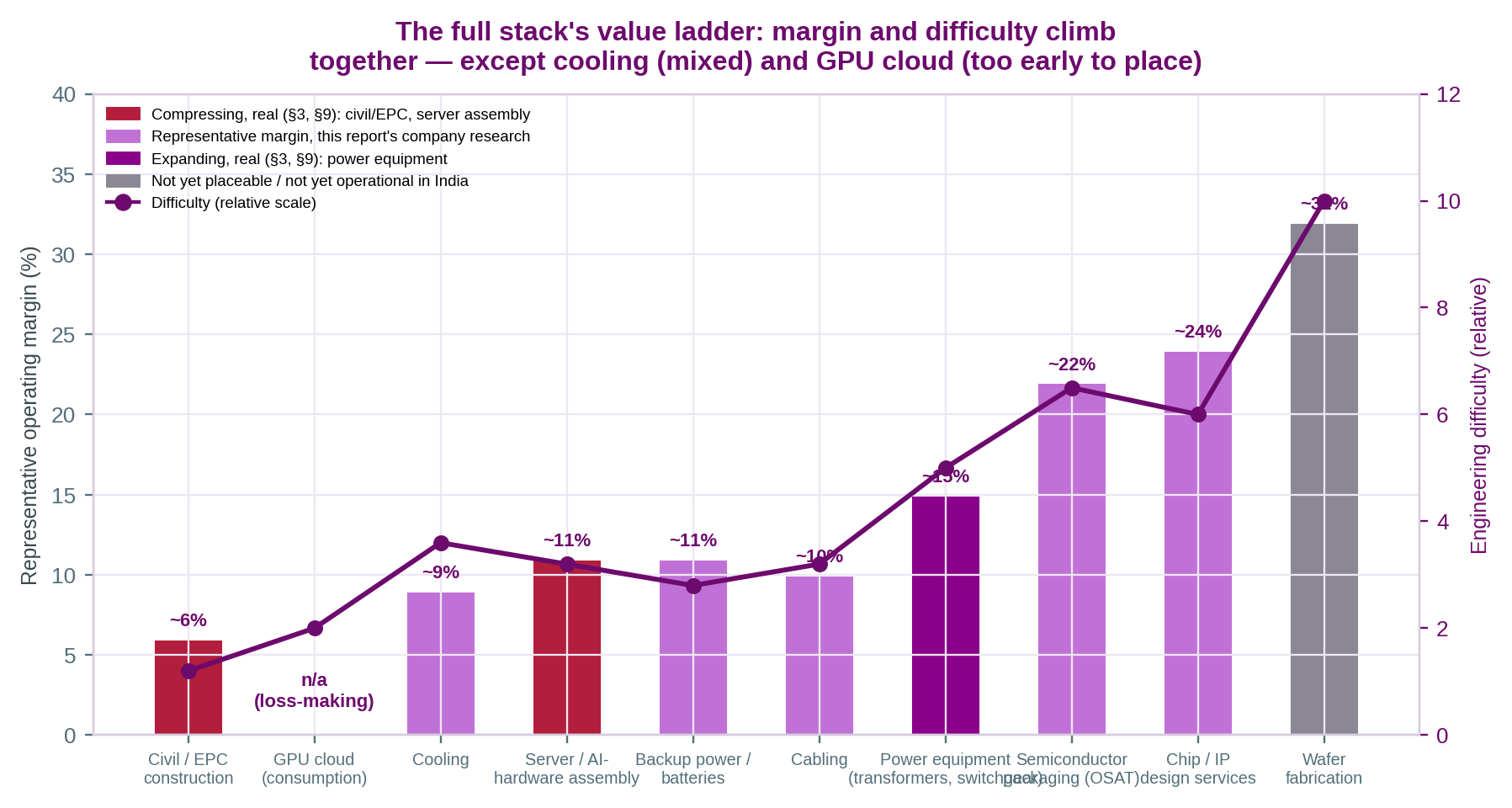
Semiconductor packaging (OSAT) sits, on a naive value-chain reading, below a branded systems integrator — it never puts its own name on a finished server. Yet a company holding one of India's few operational packaging lines can plausibly hold more durable pricing power than a much larger, more visible AI-server assembler, precisely because packaging capacity is nationally scarce and government-incentivised, while server-assembly capacity is not.
Precision cooling (CRAC/CRAH units) and data-centre-grade UPS — the exact equipment behind the globally recognisable APC, Vertiv and Stulz brands — are supplied in India almost entirely by unlisted multinational subsidiaries. A public-markets investor cannot buy this specific, highly visible layer of the stack on the Indian exchanges today. This is the mirror image of the OSAT exception above: one is a hidden layer holding real value; the other is a visible layer holding none, at least not on the public markets.
| Layer | Where the margin evidence points | Companies in §9 |
|---|---|---|
| Chip / IP design services | Undisclosed at the segment level everywhere; a structurally undercounted layer (§8) | LTTS, Cyient, Sasken |
| Semiconductor packaging (OSAT) | Indicative ~20-24%; the low-visibility, high-value exception above | Kaynes Technology, CG Power |
| Server / AI-hardware assembly | Thin (~10-14%) and reported to be compressing industry-wide, generation over generation | Netweb, Dixon, Syrma SGS |
| GPU cloud / compute consumption | Currently loss-making or single-contract- concentrated; too immature to place on the ladder with confidence | E2E Networks, ESDS Software Solution |
| Power equipment (transformers, switchgear, grid tech) | Most consistently expanding/scarce of any physical layer — Hitachi Energy India's 7%→9.3%→15.4% climb | Voltamp, Hitachi Energy India, ABB India, GE Vernova T&D, Siemens Ltd, Siemens Energy India, Schneider Electric Infrastructure |
| Backup power / batteries | ~11-14%, thin DC-specific evidence | Amara Raja Energy & Mobility |
| Cooling | ~8-9%, genuinely mixed/volatile — this report's one physical-layer exception to the "engineered = expanding" rule | Blue Star, Voltas, Thermax |
| Cabling | ~10%, stable-to-strong, real product differentiation | Sterlite Technologies, Polycab, KEI Industries, Finolex Cables |
| Civil / EPC construction | Thinnest and most consistently compressing layer in this report's entire universe — ~5-6% | Techno Electric & Engineering, KEC International, Kalpataru Projects International, Ahluwalia Contracts |
| Data-centre-adjacent telecom & conglomerates | Not meaningfully placeable — DC exposure is a rounding error inside a much larger, differently-driven business | RailTel, Anant Raj, Bharti Airtel, Tata Communications, Adani Enterprises, L&T |
Source: Dart Consultants, from each company's own report in Part 4. A company's placement reflects where its data-centre/AI-relevant business sits, not necessarily its entire revenue base.